The Five LevelsIn the Taittiriya Upanishad, the individual is represented in terms of five different sheathsor levels that enclose the individual's self. These levels, shown in an ascending order, are:
The physical body (annamaya kosha)
Energy sheath (pranamaya kosha)
Mental sheath (manomaya kosha)
Intellect sheath (vijnanamaya kosha)
Emotion sheath (anandamaya kosha )
These sheaths are defined at increasingly finer levels. At the highest level, above the
emotion sheath, is the self. It is significant that emotion is placed higher than the intellect.
This is a recognition of the fact that eventually meaning is communicated by associations
which are influenced by the emotional state.
The energy that underlies physical and mental processes is called prana. One may look
at an individual in three different levels. At the lowest level is the physical body, at the next
higher level is the energy systems at work, and at the next higher level are the thoughts.
Since the three levels are interrelated, the energy situation may be changed by inputs either
at the physical level or at the mental level. When the energy state is agitated and restless,
it is characterized by rajas; when it is dull and lethargic, it is characterized by tamas; the
state of equilibrium and balance is termed sattva.
The key notion is that each higher level represents characteristics that are emergent
on the ground of the previous level. In this theory mind is an emergent entity, but this
emergence requires the presence of the self.
The Structure of the Mind
The Sankhya system takes the mind as consisting of five components: manas, ahankara,
chitta, buddhi, and atman
Manas is the lower mind which collects sense impressions. Its perceptions shift from
moment to moment. This sensory-motor mind obtains its inputs from the senses of hearing,
touch, sight, taste, and smell. Each of these senses may be taken to be governed by a separate
agent.
Ahankara is the sense of I-ness that associates some perceptions to a subjective and
personal experience.
Once sensory impressions have been related to I-ness by ahankara, their evaluation and
resulting decisions are arrived at by buddhi, the intellect. Manas, ahankara, and buddhi are
collectively called the internal instruments of the mind.
Next we come to chitta, which is the memory bank of the mind. These memories con-stitute the foundation on which the rest of the mind operates. But chitta is not merely
a passive instrument. The organization of the new impressions throws up instinctual or
primitive urges which creates different emotional states.
This mental complex surrounds the innermost aspect of consciousness which is called
atman, the self, brahman, or jiva. Atman is considered to be beyond a finite enumeration of
categories.
All this amounts to a brilliant analysis of the individual. The traditions of yoga and
tantra have been based on such analysis. No wonder, this model has continued to inspire
people around the world to this day.
Lokas, the Planets of Advanced Aliens
All Creations of God stretch Infinitely, All Times, Past, Present and
Future, Worlds imagined and unimagined.. Everything that Can be,
Everything that Cannot be, All exist somewhere.. Beyond this world are
myriad worlds, And beyond all worlds, Is the One that is Eternal.. The
Hindu New Year has just started and Chaitra Navratri gets over today.
Calculations tell us that we are in the 5114th Year of the Era of
Kaliyuga, a thought that was enough to get me started on an exploration
of the scriptures once again. Hindu scriptures have always used
mind-boggling numbers for the Age of the Universe and the Gods
inhabiting it. For example, Brahma, the Creator-God, has an impressive
life span that runs into trillions of Solar Years! The 'Chemical locha'
in my brain makes me look for a scienctific sub-text in every religious
text that I read. How can it be, that the demi-gods and their Superior
gods have such long time-spans that make them seem almost IMMORTAL to
us?? For some time now, I have been nursing this notion- COULD the
multi-limbed gods and goddesses with super-human abilities, space-crafts
and atomic-weaponry, be actually super-advanced ALIENS with a keen
interest in our world?? Gods as Alien Benefactors of Human-kind I
don't intend this statement to be blasphemous, as I myself am as much a
Man of FAITH as of SCIENCE and completely believe in the Divinity of
Supreme Lord and the Holy Trinity. What I propose here is a new
understanding of the DEMI-GODS as denizens of the same Universe living
on different planets called LOKAS. They have access to highly advanced
Science (that we percieve as supernatural abilities) and a much better
grasp of the Supreme Lord's Cosmic Plan! Of course, they are Spiritually
more advanced too and perform their individual roles in running the
Universe impeccably viz. Indra-the Lord of Rain, Varun-the Lord of
Oceans and Yamaraj-the Lord of Death. Could the Scientific advancement
of these beings have resulted in their extended life-spans as well?? To
us, the World seems to be ending, but our Brahma has JUST hit
Middle-age, and is currently near the Noon of the 1st Day of the 51st
year of his life! By my calculation, Lord Brahma's current age of 50
Deva Years (~155 Trillion Human Years) + Half a Day (~1.85 Billion
Years) amounts to the massive figure of 155.521852 Trillion Solar Years
which would also be the Age of OUR Universe approximately!! Brahma,
the 150 Trillion Year old God! It is noteworthy that unlike any
other belief system in the World, Hindu Cosmology talks about Time
frames that are even FURTHER in the mists of time than the
approximations arrived at by current Science (Age of Universe - 14
Billion years). Whether we consider them advanced aliens or demi-gods,
these beings would be FAR FAR Superior to us in Scientific as well as
Spiritual pursuits and we should keep that in our mind while reading
about their super-human feats in the ancient chronicles. Respecting the
authority of these same sources, in this post, let us embark on a
journey of Scriptural Space-Exploration. Do Aliens Exist? Our
planet is the only KNOWN planet which has given birth to Life; however,
it does not follow that it is the ONLY one capable of supporting Life!
There are Billions and Billions of Stars in each Galaxy; Billions of
Galaxies in each Universe, and as we learnt in the 2nd post (Black Holes
and Bhagavatam), Billions of Universes in the Material Creation!! It is
more likely than not, that Life in its myriad forms exists in not just
one but many other planets as yet undiscovered by the human race.
Billions of stars in our Galaxy Milky Way Trillions of Galaxies in the
Universe Zillions of Universes emerging from Shri Maha-Vishnu
Scientifically, it is still undetermined whether the universe exists by
itself or is just one of the countless trillions within a larger
Multiverse, itself contained within the Omniverse that is the Material
World. Even if we forget the Multi-verse and Parallel Universes we
encountered in a previous post, there are still enough planets within
our OWN Universe, which could be inhabited by alien species. Here, I
would quote my favorite author, Arthur C. Clarke to put a very valid
point across- Almost certainly there is enough land in the sky to give
every member of the human species, his own private world! But how many
of those potentially habitable worlds are ALREADY inhabited, we have no
way of knowing! Yet, as he quite eloquently states, the barriers of
distance are crumbling; one day SOON we may meet our Equals, or our
Masters, among the stars. Advanced Aliens from a Hollywood flick
Sadly, Human race today, is like the proverbial Frog-in-the-well. We
have been cocooned by our Atmosphere and sheltered from the harsh
realities of Universe for so long, that we just can't remember how
things are outside of it. But there are entire Solar Systems, Galaxies
and even Universes that are inaccessible to us right now and it would be
good to remember the plausability of Life existing somewhere out there.
Different Worlds in Our Universe Let us begin our journey with a
brief insight into our current place in the Universe by means of this
animation: Zoom out from Earth to the Universe It would be
immediately clear from this video that we are an extremely tiny and
insignificant part of this gigantic Universe and there are billions and
zillions of worlds out there about which we have absolutely no clue even
today. Fortunately for us, the Ancients were NOT as short-sighted or
limited by Scientific Theories as we are today, and have described
planets, galaxies and even multiple Universes in this Material Realm
which would act like what Science calls an Omniverse. The Puraans give
THREE different divisions of our Universe and label them as the:
Urdhva-loka (Highest abodes), Madhya or Bhu-loka (Middle ones), and
Adho-loka (the Lower realms). Various scriptures talk about these
different realms within Material Creation. In the Great War of
Mahabharat, when Arjuna faltered in his duty, Lord Krishna gave him the
Divine discourse of Shrimad Bhagavad Geeta, and let him have a glimpse
of His Supreme Virat-Roop. In this Universal Form of the Lord, Arjun
could see the entire cosmos. Eternity manifests itself in endless ways
on endless planes of existence and from head to toe, Arjuna saw the body
of Lord Krishna encompassing 14 different planetary dimensions!!
Virat Roop of Lord Vishnu Let us try to understand what the fourteen
planetary systems or Lokas refer to and what is their geographical and
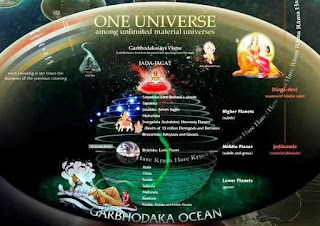
spatial arrangement. Lokas in Our Universe Each Universe is shaped
like an egg (Brahmand) and within it exist the three levels of Lokas.
There are 14 planetary systems comprising the three Lokas and below them
exist the 28 different Hells. Brahmand and its Lokas The
Hari-vamsha says that Higher planetary systems are the realms of Devas,
Angels, Spirits and Manes; Middle Planets (Bhu-Loka) the abode of mortal
beings like Humans and animals; and the Lower planets are populated by
the Demons and Nagas. Since the names in the Image above may not be very
clear, I am jotting down the 14 systems here: Higher Lokas -
Lower Lokas Satyaloka 1 Atal Tapoloka 2 Vital Janloka 3 Sutal Maharloka 4
Rasatal Swargaloka 5 Talatal Bhuvarloka 6 Mahatal Bhuloka 7 Patal All
these planets are within the material world and under the control of
Devi Durga, therefore the Material Creation is also known as Devi-dham.
Development of higher consciousness, starts with human beings, and
further increases among the denizens of higher planetary systems. Our
Earth is situated close to the middle of these planetary systems and
represents the Mortal Realms known as the Bhu Mandala. Jain Scriptures
also describe a similar form known as the Lok-purush or the Cosmic Man.
The torso and head of the Cosmic Man contain a series of heavenly realms
where the inhabitants experience lives of pleasure. The legs represent a
series of seven hells, which offer an endless variety of torments.
Lokas in Jain cosmology For us, the most important part of the
universe, is the disk at the Loka-purush's waist, representing the
MIDDLE-WORLD, where humans live and great teachers can be born. In this
post, I shall take you through the 14 planetary systems starting with
the Top planets first and gradually progressing to the Lower ones.
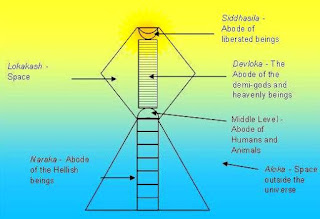
URDHVA-LOKA or The Higher Planets The Higher Planets are abodes of
super-intelligent, super-human, semi-divine and spiritually advanced
beings. Loosely they may be understood as the Heavenly planets compared
to the Middle Realm of Earth-like planets and the lower Hellish realms.
Comparative arrangement of Lokas This group contains SIX planetary
systems shown in the image above as the top six Lokas. The lowest of
these, the Bhuvar-Loka, lies immediately above the Earthly Realm or
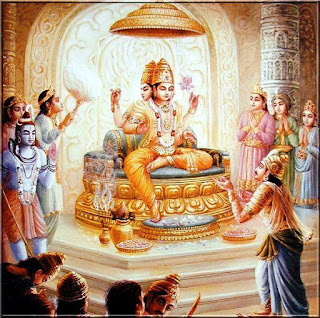
Bhu-Loka. SATYA-LOKA The HIGHEST planet in the Material Realm is
the abode of Lord Brahma, the progenitor of this universe. Along with
him are present, his consort Saraswati and other spiritual entities who,
after eons of spiritual penance have been able to transcend the bonds
of Material world and reach this plane by traversing through the Milky
Way. Satya-Loka or Brahma-Loka At the time of final dissolution of
the material planets the residents here transform their subtle bodies
into spiritual bodies and enter the eternal Vaikuntha planets which
begin 26,200,000 yojanas ABOVE the Satyaloka. TAPO-LOKA This is the
abode of the four Kumars named Sanat, Sanak, Sanandan, and Sanatan and
is located 120,000,000 yojanas below the Satya-Loka. They are the first
incarnations of Lord Vishnu and represent the Gyan-shakti (power of
knowledge) of the Lord. They are collectively referred to as the Kumars
because they are immortal and live for the entire duration of universal
time, yet retain their appearance of 5 year old kids! The 4 Kumars
preaching Supreme Knowledge Because of their pure nature, they have
easy access to the Brahma-Loka as well as the Spiritual Realm and
regularly visit Lord Vishnu in the Vaikuntha. JANA-LOKA &
MAHAR-LOKA The next Loka lies 80,000,000 yojanas below the Tapaloka and
is the abode of great rishis. 20,000,000 yojanas below Janaloka is the
Maharloka which is another abode of great saints and sages. These Lokas
are populated by mystics who can move between any planets within the
material universe at speeds unthinkable to modern Science and the
greatest of sages, such as Bhrigu Muni, live in this place. The
inhabitants have a life span of one whole day of Brahma (4.32 Billion
years)! Sages of Jana-Loka and Mahar-loka worshipping the Lord When
the fire of devastation reaches this planet the residents transport
themselves to Satyaloka where they live further before the highest of
planets is also destroyed. They then transform their subtle bodies to
spiritual and enter the spiritual realms. Here, by means of his Karma, a
soul can either go higher, up to Satyaloka and become Brahma's
associate, or down, to the level of the Devas or demigods.
SWARGA-LOKA The abode of the 33 Vedic gods also known as the
Trayastriṃśa in Buddhist cosmology is located on the peak of Mount Meru,
the central mountain of the world, at a height of 80,000 yojans. This
Loka corresponds to the concept of Heaven as described in the Western
sense of the term. Here the King of the Gods, Indra rules with his
brothers and companions. His entourage comprises of Angels, Gandharvas,
Apsaras, Maruts, Vasus and other divine beings. The Heavenly Realm
This is one of the most opulent planetary system with unimaginable
riches, wish-fulfilling trees, supersonic space-crafts, ability to
travel in different dimensions, long life-spans, and freedom from
disease and disability. The duty of these Demi-gods is to manage the
affairs of the universe, protecting its inhabitants against the demons.
The capital city of this world is Amravati - Abode of the Immortals.
Indra and his fellow-residents obtain all the pleasures of life because
of the wish-fulfilling cow Kamdhenu. This divine cow, the three-headed
White Elephant Airavat as well as the Flying Horse Uchhaihshrava (~Greek
Pegasus) were the riches Indra obtained after the Churning of the
Cosmic Ocean. Indra riding the winged-horse Ucchaihshrava
However, the 33 gods do not have a completely worry-free life here. In
particular, they find themselves frequently challenged by the Asuras who
dwell at the foot of Sumeru, plotting for ways to overthrow the Devas
and take over their kingdom. Devas getting ready for a battle with
Asuras Image courtesy Grant Morrison's 18 Days {Art by Mukesh Singh}
Scriptural references make it equivalent to the Biblical Heaven or
Islamic Jannat where the good souls go after death to reap the benefits
of their good Karma. If they become advanced in devotional service,
they can advance to one of the higher Munilokas but if they become
attached to material enjoyment, they will degrade into a lower position
of a semi-divine being of even a Human again.
Source https://www.facebook.com/ancientindianufo


