Showing posts with label of. Show all posts

Tuesday, September 24, 2013

Nature of the soul & Its Destiny


MINDBOGGLING~Ancient Hindus Knew:Nature of the soul & Its Destiny


Hello Every one . Those people who ask for PROOF - SCIENTIFIC PROOF Must realise that today's Modern day science is a MIDGET Technology when compared with Ancient Hindu Science/ Sanatana Dharma . Hindu Scripts already have every thing From ATOM to UNIVERSE and beyound that in Details . 
Modern Science is just re-Discovering what Ancient Hindus already Discovered for many 100000s of Years ago . It will be laughable when you see the number i mentions more than 1 lacs years ago. But As I said this will also be proved correct when our Science and technology advanced as today we know VIMANAS were True because we advanced a bit closer to UFO technology .

Lets focus on ATMAN~ SOUL . If you read our previous Posts on : PROOF OF SOUL ! ! ! { https://www.facebook.com/photo.php?fbid=505824716175925&set=a.505821629509567.1073741904.182221931869540&type=1&theater } It was proved by Russian Scientist . Now Lets see What Hinduism / Sanatana Dharma / INDIANS knew about Soul : Enjoy and Please SHARE it withh all your friends and Family .Spread the words . _/\_

Understanding Hindu Science ~ Ātman . Ātman (Hinduism), meaning 'self' is a Sanskrit word that means 'inner-self' or 'soul'. In Hindu philosophy, especially in the Vedanta school of Hinduism, Ātman is the first principle, the true self of an individual beyond identification with phenomena, the essence of an individual. In order to attain salvation (liberation), a human being must acquire self-knowledge (atma jnana), which is to realize that one's true self (Ātman) is identical with the transcendent self Brahman:
If atman is brahman in a pot (the body), then one need merely break the pot to fully realize the primordial unity of the individual soul with the plentitude of Being that was the Absolute.

The Vedanta philosophy discusses the
nature of the soul from two standpoints:

1. Absolute or transcendental and
2. Relative or phenomenal.

From the absolute standpoint, the soul is non-dual, immortal, ever pure, ever free, ever illumined, and one with Brahman. It is untouched by hunger or thirst, good and evil, pain and pleasure, birth and death, and the other pairs of opposites. That is the soul's true nature. The realisation of which is the goal of a man's spiritual aspiration and striving. From this absolute standpoint, the soul is called PARAMATMA or Supreme Soul.

But from the relative standpoint, the Vedanta philosophy admits the existence of a multitude of individual souls called JIVATMAS, and distinguishes them from the Supreme Soul. Attached to the body, the individual soul is a victim of the pairs of the opposites. Entangled in the world, it seeks deliverance from the eternal round of birth and death, and with that end in view, studies the scriptures and practises spiritual disciplines.

The embodied soul is associated with the sense organs, the mind and vital breath (Prana). There are ten sense organs, all subordinate to the mind as the central organ; five organs of perception and five organs of action. The five organs of perception comprise the organ of taste (tongue),smell (nose), vision (eyes), hearing (ear), and touch (skin). The five organs of action are the hands, the feet, the organ of speech, the organs of evacuation and the organ of generation.

The four functions of the mind

The mind is the inner organ and consists of such functions as desire, deliberation, doubt, faith, want of faith, patience, impatience, shame, intelligence and fear.

The impressions carried by the organs of perception are shaped by the mind into ideas, for we see only with the mind, hear with the mind. Further, the mind changes the ideas into resolutions of the will.

There are four functions or divisions or parts of the mind.

One part of the mind called Manas, creates doubt.
The Buddhi (intellect) makes decisions
Chitta is the storehouse of memory
Aham (the ego), creates I-consciousness.
The five organs of action, the five organs of perception, the five pranas, the mind, and the intellect constitute the gross and the subtle body of the embodied soul (jiva). The subtle accompanies the individual soul after death, when the gross body is destroyed. The subtle body is the abode of the KARMA or impressions left by action, determining the nature of the new body and mind when the soul is reborn. As the jiva (the embodied soul) does and act, so it becomes.

The presence of an irrefragable Self or consciousness is assumed in all acts of thinking. The Self or consciousness, which is the true 'seer' or subject, is unchanging intelligence, and can never be imagined to be non-existent. Atman (the Self) in man and Brahman in the universe are completely identical.

The idea of body, senses, and the mind, associated with the non-self, is falsely superimposed upon the Self, and the Self, which is of the nature of pure consciousness, appears as a jiva, or phenomenal being, subject to the various limitations of the physical world.

Death, according to Hinduism, is a series of changes through which an individual passes. The Brihadaranyaka Upanishad describes thus the passing of a soul:
When the soul departs from the body, the life-breath follows: when the life-breath departs, all the organs follow. Then the soul becomes endowed with particularized consciousness and goes to the body which is related to that consciousness. It is followed by its knowledge, works, and past experience. Just as a leech supported on a straw goes to the end of it, takes hold of another support, and contracts itself, so does the self throw this body away and make it unconscious, take hold of another support, and contract itself. Just as a goldsmith takes a small quantity of gold and fashions another - a newer and better - form, so does the soul throw this body away, or make it unconscious, and make another - a new and better - form suited to the Manes, or the celestial minstrels, or the gods, or Virat, or Hiranyagarbha, or other beings. . As it does and acts, so it becomes; by doing good it becomes good, and by doing evil it becomes evil - it becomes virtuous through good acts and vicious through evil acts.

Hinduism speaks of the four courses that men follow after death. The first, called devayana, way of the gods, is followed by spiritually advanced souls who lead an extremely pure life, devoting themselves to wholehearted meditation on Brahman, but who have not succeeded in attaining complete Self-knowledge before death. They repair to Brahmaloka, the highest heaven, and from there in due course attain liberation. The description of this path in the Chhandogya Upanishad is as follows:

Now, such a one-whether his after-death rites are performed or not-goes to light, from light to day, from day to the bright half of the month, from the bright half of the month to the six months during which the sun rises northward, from the months to the year, from the year to the sun, from the sun to the moon, from the moon to the lightning. There he meets a person who is not a human being. This person carries the soul to Brahman. This is the divine path, the path of Brahman. Those proceeding by this path do not return to the whirl of humanity.

The second course, known as pitriyana, way of the fathers, is followed by ritualists and philanthropists who have cherished a desire for the results of their charity, austerity, vows, and worship. Following this path, they repair to Chandraloka, the lunar sphere, and after enjoying immense happiness there as a reward for their good actions, they return again to earth since they still have earthly desires. The third course, which leads to hell, is followed by those who led an impure life, performing actions forbidden by the scriptures. They are born in sub-human species. After expiating their evil actions, they are again reborn on earth in human bodies. The fourth course is for those who are extremely vile in their thoughts and actions. They are reborn again and again as insignificant creatures such as mosquitoes and fleas. Eventually, after the expiation of their evil actions, they too return to human bodies on earth. When a soul assumes a human body, it takes up the thread of spiritual evolution of its previous human birth and continues to evolve toward Self-knowledge. According to Hinduism, all souls will ultimately attain Self-knowledge. The four courses do not apply to those souls who attain Self-knowledge before or at the time of death. For these souls there is no going to any realm. Upon their death, their souls become absorbed in Brahman, and the elements of their body-mind complex return to their original source.


From the point of view of Hinduism, dying may be compared to falling asleep and after-death experiences to dreams. The thoughts and actions of the waking state determine the nature of our dreams. Similarly, after death the soul experiences the results of the thoughts it entertained and the actions it performed during its life on earth. After-death experiences are real to the soul, just as a dream is real to the dreamer, and may continue for ages. Then, when the soul wakes up after this sleep, it finds itself reborn as a human being. According to the Hindu scriptures, some souls after death also may be born as human beings without going through the experiences of heaven or hell. There is no real break in the spiritual evolution of the soul toward Self-knowledge. Even the soul's lapse into sub-human birth from human life is a mere detour. A dying man's next life is determined by his last thought in the present life. The Bhagavad Gita says: "For whatever objects a man thinks of at the final moment, when he leaves the body - that alone does he attain, O son of Kunti, being ever absorbed in the thought thereof." And the last thought of the dying person inevitably reflects his inmost desire. These different courses after death have been described to warn people against neglecting the path of Self-knowledge, which alone can confer immortality and eternal peace and happiness.

Thursday, June 6, 2013

Mettalurgy in Ancient India


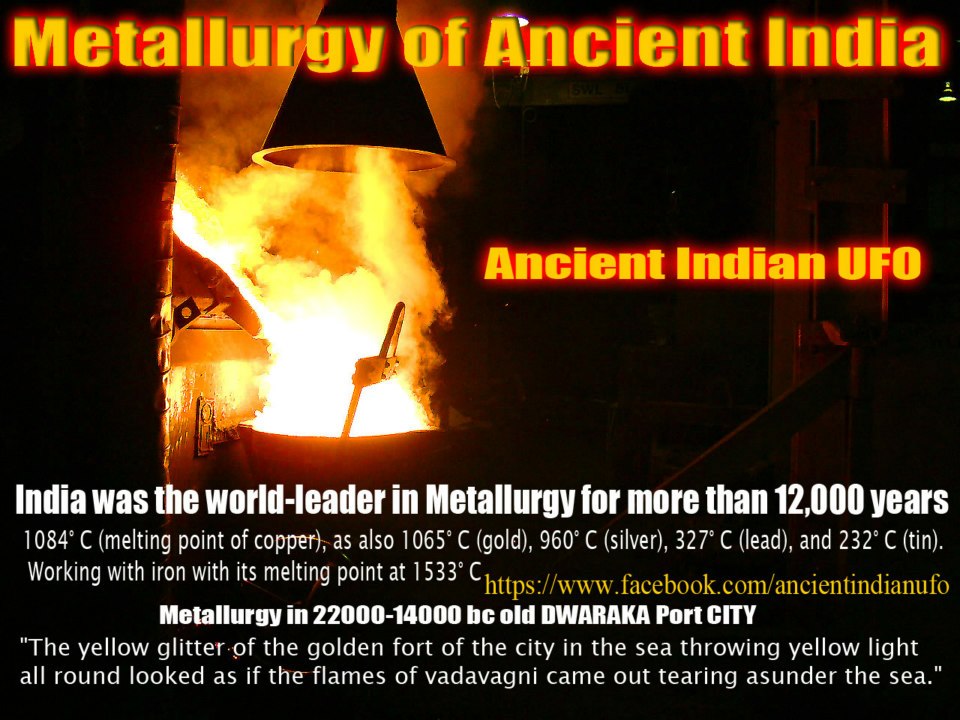
India was the world-leader in Metallurgy for more than 22,000 - 14000 bc years. Dwaraka City found recently Is the city of Gold.One parah says: "The yellow glitter of the golden fort of the city in the sea throwing yellow light all round looked as if the flames of vadavagni came out tearing asunder the sea." The city had 700,000 palaces made of gold, silver and other precious stones.

Gold jewelery is available from 3,000 BCE. Brass and bronze pieces are dated back to 1,300 BCE. Extraction of zinc from ore by distillation was used in India as early as 400 BCE while European William Campion patented the process some 2,000 years later. Copper statues can be dated back to 500 CE. There is an iron pillar in Delhi dating back to 400 CE that shows no sign of rust or decay. The earliest know book on metallurgy was known to be written by Nagarjuna in 10th century. The book Rasaratnanakara addresses various metallurgical topics such as: Preparation of liquids (rasas) such as MercuryExtraction of metals like Gold, Silver, Tin, and Copper from their ores and their purificationThe processes of liquefaction, distillation, sublimation, and roastingIndia was invaded by Mohammedans during the time of Nagarjuna. It is possible that Nagarjuna’s texts fell into the hands of the invaders, who could have transmitted these Indian Metallurgical sciences to the outside world. Metallurgy in India has a long and varied history. Bronze and copper were known during the period of the Indus Valley Civilization. The recovery of metal articles (including a bronze dancing girl) and the discovery of crucible with slag attached are clear indicators of the knowledge of casting (pouring molten-hot metal into moulds of the desired shape and size) and forging (hammering hot metal into required shapes). Further, this points to the fact that these early peoples could produce and handle temperatures as high as 1084° C (melting point of copper), as also 1065° C (gold), 960° C (silver), 327° C (lead), and 232° C (tin). Working with iron with its melting point at 1533° C was inarguably a later achievement. Mohenjodaro, Harappa and Lothal are the three major sites of this civilization. At Lothal in the state of Gujarat, two types of kilns have been excavated, One, a circular kiln that measures 1 metre in diameter, that was most probably used for smelting copper ingots; the second, a rectangular kiln measuring 75 by 60 cms. with a depth of 30 cms. This is believed to have been used for casting tools. The many metal discoveries at Lothal include figure, amulets, pins in the shape of a bird-head, miniature figures, and tools such as a curved or circular saw, a needle with an eye at the piercing end, and a bronze drill with twisted grooves. This last is by far the most important find of ancient tools because this single item led to an unparalleled precision at the time, and is widely regarded as the precursor to modern machine tools. The above-mentioned tools are exceptional in the entire Indus Valley civilization, and neither do they bear resemblance to Harappan tools. Indeed, Lothal was already a prosperous town prior to the arrival of the Harappans sometime around 2450 BC and till 1600 BC. One thousand and fifty BC is usually accepted as the year the Iron Age began in most of India. Iron is mentioned by the Atharvaveda, referred to specifically as ayas. Previous to this, the Vedas used the term ayas as a generic one for metals : the Brahmanas and the Upanishads referred to Lohitayas (i.e. red metal or copper) and Krishnayas (i.e. black metal). One thousand BC is the accepted date for the appearance of extracted iron. Iron and its technology gave momentum to the process of urbanization, and the lives of the peoples changed in reflection. Iron was closely associated with : o Painted Grey Ware Culture — the iron objects of this association date back to 1025 +/- 110 BC. Excavations have revealed arrowheads (including leaf-shaped ones), daggers, hoes, adzes, spearheads with tongs, fish hooks, and plain tongs. A vital site – Atranjhikera – has yielded implements at practically every level of excavation! Other sites are Hastinapur, Alamgirpur, Kausambi and Ujjain. o Black-and-Red-Ware-Culture — objects discovered at Eran in the state of Madhya Pradesh date back to 1250 BC and 700 BC, according to C14 dating. Another site, Nagda, has 59 objects, all belonging to the period 750-500 BC. These include a double-edged dagger, the round socket of a broken axe, arrowheads with a biconical cross-section, a celt with a wide cutting edge, spoon, nails, clamps, and knife blades. o Megalithic Culture — While the rest of the country proceeded from the Neolithic to the Copper and then to the Iron Age, South india moved directly from the Neolithic to the Iron Age. At Hallur, the Iron Age is believed to have begun in 1105 BC, while the rest of the South coincided with the North i.e. approximately between 1050 and 950 BC. Spread throughout this region, implements and tools are marked by their similarity. Flat iron axes, sickles, spades, daggers, swords, knives, chisels, tripods, horse-bits, frying pans, ladles and even bangles – all point to a usage for both domestic and warfare purposes. Taxila stands apart due to the clear Graeco-Roman influence, for example, ladles with vertical handles, folding chairs, candelbras, plate armour for men and horses, cheekbars. Of special interest are the arrowheads that are distinctly Mediterranean in style, and made their appearance in both distant regions in AD 1! The Special Four 1) The Iron Pillar in the Qutb Minar complex at New Delhi is an AD 310 structure, and has survived corrosion-free! It stands at 23 feet & 8 inches, upper diameter – 12.5 inches, lower diameter – 16.5 inches, and weighs 6 tonnes. Analysis of the pillar – iron: 99.720%, carbon: 0.080%, silicon: 0.046%, sulphur: 0.006%, phosphorus: 0.114%, manganese: negligible. The low levels of sulphur and manganese, and the relatively high level of phosphorus, are credited with its rust-free existence. 2) Iron Pillar at Dhar (near Indore) is believed to have been built during Chandragupta Vikramaditya’s reign, between AD 375 – 413. Originally 50 feet in height, it has an average cross-setion of104 square inches, and weighs 7 tonnes. Unfortunately, the pillar is now in three parts. 3) Iron beams (29 of them) at the temple at Konark (near Puri) – the largest measures 35 feet by 6 inches, and the second in size, 25 feet by 6 inches. Both have a cross-section of 11 inches by 11 inches. The temple was constructed sometime around AD1240. 4) The 232 beams of the twelfth century Gundicha Bedi Temple at Puri! The longest beam is 17 feet in length, and cross-sections of the beams vary from 6 inches by 4 inches to 5 inches by 5 inches. In Arthasastra : The Wisdom of the Wise: Kautilya’s magnum opus, the Arthashastra, is regarded by many a scholar as the last word in sense and cunning. Here, we briefly focus on the former aspect! Written in the fourth century BC, the work discusses metals and minerals, the purification of their ores, the extraction and working of metals, as well as their alloys. On one hand, the book suggests the purification of ores by chemical treatment with iron or alkalis (i.e. plant ashes). On the other, it recommends the use of charcoal and chaff (waste products of food preparation) in limekiln and for smelting iron. Clearly, recycling mattered! In addition, there are pointers to the location of mineral deposits. The Arthasastra lays down the role of the Director of Metals, the Director of Forest Produce and the Director of Mining. It is the duty of the Director of Metals to establish factories for different metals. The Director of Mines is responsible for the inspection of mines. The Arthasastra also refers to counterfeit coins. The Rig Veda refers to ayas, and also states that the Dasyus had Ayas (RV 2.20.. In RV 4.2.17, “the gods [are] smelting like copper/metal ore the human generations”. The references to Ayas in the Rig Veda probably refer to bronze or copper rather than to iron. The Atharva Veda and the Satapatha Brahmana refer to krsna ayas (“black metal”), which could be iron (but possibly also iron ore and iron items not made of smelted iron). There is also some controversy if the term syamayas (“black metal) refers to iron or not. In later texts the term refers to iron. In earlier texts, it could possibly also refer to darker-than-copper bronze, an alloy of copper and tin. Copper can also become black by heating it. Oxidation with the use of sulphides can produce the same effect. The Yajurveda seems to know iron. In the Taittiriya Samhita are references to ayas and at least one reference to smiths. The Satapatha Brahmana 6.1.3.5 refers to the smelting of metallic ore. In the Manu Smriti (6.71), the following analogy is found: “For as the impurities of metallic ores, melted in the blast (of a furnace), are consumed, even so the taints of the organs are destroyed through the suppression of the breath.” Metal was also used in agriculture, and the Buddhist text Suttanipata has the following analogy: “for as a ploughshare that has got hot during the day when thrown into the water splashes, hisses and smokes in volumes…” In the Charaka Samhita an analogy occurs that probably refers to the lost wax technique. The Silpasastras (the Manasara, the Manasollasa (Abhilashitartha-Chintamani) and the Uttarabhaga of Silparatna) describe the lost wax technique in detail. The Silappadikaram says that copper-smiths were in Puhar and in Madura. According to the History of the Han Dynasty by Ban Gu,Kashmir and “Tien-chu” were rich in metals. An influential Indian metallurgist and alchemist was Nagarjuna (born 931). He wrote the treatise Rasaratnakara that deals with preparations of rasa (mercury) compounds. It gives a survey of the status of metallurgy and alchemy in the land. Extraction of metals such as silver, gold, tin and copper from their ores and their purification were also mentioned in the treatise. The Rasa Ratnasamuccaya describes the extraction and use of copper. He wrote the treatises Rasaratnakara, Rashrudaya and Rasendramangalthat deals with preparations of rasa (mercury) compounds. It gives a survey of the status of metallurgy and alchemy in the land. Extraction of metals such as silver, gold, tin and copper from their ores and their purification were also mentioned in the treatise. He also wrote Uttaratantra as a supplement to Susrutasamhita, dealing with preparation of medicinal drugs, and an Ayurvedic treatise, Arogyamanjari. His other treatises are Kakshaputatantra, Yogasara and Yogasatak. Because of his profound scholarliness and versatile knowledge, he was also appointed as Chancellor of the famous University of Nalanda. Varahamihira in the sixth century AD indicates the hardening of steel in his Khargalakshanam:: ” The red hot steel should be plunged into a solution of plantain ashes in whey, which is kept standing for twelve hours and then it should be sharpened on the lathe.” Vrinda discussed the process of killing iron (i.e. obtaining iron oxides). He insists that iron first be ignited in fire and then immersed in the juices of Emblic myrobalan and Trewia nundiflora. Next, it should be exposed to sunlight, and then again macerated in certain other plant juices. Last, it should be placed in a mortar and rubbed. The twelfth century Brahmanical Tantric text Rasarnava holds forth on the colour of flames, the processes of killing metals, and the test of a pure metal. The last – ”A pure metal is one which when melted in a crucible does not give off sparks nor bubbles, nor spurts, nor emits any sound, nor shows any lines on the surface but is tranquil like a gem.” Another text Rasaratnasamuchchaya speaks of iron as one of the pure metals, and the three categories thereof: (i) Mundam (wrought iron) is of three types – one is the mridu, that is glossy, will melt easily but is difficult to break; the second, kunthum, that does not melt easily; and the kadaram that will easily break under the hammer; (ii) Tikshnam (cast iron steel) – of six types, ranging from the line-free and rough and breakable type to the sharp-edged type that is difficult to break. (iii) Kantam is of five types – bhramaka (that can make iron move about), chumnbaka (that which ‘kisses’ iron), karshaka (that which attracts iron), dravaka (which melts iron easily), romakanta (which expels hair-like filaments upon breaking). Other metals: Zinc mining and smelting were known in the fourteenth century, and soldering was a common practice. By the eighteenth century, steel manufacture was a regular industry, particularly in Mysore. Seringapatnam was famous for its steel wires for musical instruments, while iron utensils and furniture were hallmarks of the smiths of Birbhum in the state of Bengal and Munger in the state of Bihar.

The Greatest Civilization ever existed on this planet EARTH. Please share and Tag with Pride.

Jai Sri Ram


Source  https://www.facebook.com/ancientindianufo

Saturday, June 1, 2013

Speed of Light discovery by Vedic Scholar Sayana


Imagine that archaeologists, digging a thousand year old virgin site in Antarctica, come across an inscription deep underground that shows the sun, and next to it the numbers 186,000 miles per second, the speed of light. What would the world do? More likely than not, this find will not be accepted by scholars. A fraud, they would say, committed for cheap fame. The reputation of the archaeologists will be ruined. If they didn’t hold tenure, they will lose their jobs. Only lunatics will support them, claiming that this proves that aliens have visited the earth from time to time. The high priests of the academy will say that even if the find was genuine it proves nothing; at best it is a coincidence. But what an astonishing coincidence! Just the right number out of an infinite different numbers! The speed of light was first determined in 1675 by Roemer who looked at the difference in the times that light from Io, one of the moons of Jupiter, takes to reach earth based on whether it is on the near side of Jupiter or the far side. Until then light was taken to travel with infinite velocity. Even Newton assumed so. But why are we talking about the absurd scenario of the archaeologists in Antarctica? Because, we are confronted with a situation that is quite similar! I am an archaeologist of texts. I read old texts from the point of view of history of science. One such book is the celebrated commentary on the Rigveda by Sayana (c. 1315-1387), a minister in the court of King Bukka I of the Vijayanagar Empire in South India. In a hymn addressed to the sun, he says that it is ``remembered that the sun traverses 2,202 yojanas in half a nimesha.” This statement could either relate to the speed of the sun or to that of light. The units are well known. For example, the Indian epic “Mahabharata”, conservatively dated to 400 BC – 400 AD, defines 1 nimesha to be equal to 16/75.3 seconds; 1 yojana is about 9 miles. Substituting in Sayana’s statement we get 186,536 miles per second. Unbelievable, you’d say! It cannot be the speed of light. Maybe it refers to the speed of the sun in its supposed orbit around the earth. But that places the orbit of the sun at a distance of over 2,550 million miles. The correct value is only 93 million miles and until the time of Roemer the distance to the sun used to be taken to be less than 4 million miles. This interpretation takes us nowhere. What about the possibility of fraud? Sayana’s statement was printed in 1890 in the famous edition of Rigveda edited by Max Muller, the German Sanskritist. He claimed to have used several three or four hundred year old manuscripts of Sayana’s commentary, written much before the time of Roemer. Is it possible that Muller was duped by an Indian correspondent who slipped in the line about the speed? Unlikely, because Sayana’s commentary is so well known that an interpolation would have been long discovered. And soon after Muller’s “Rigveda” was published, someone would have claimed that it contained this particular “secret” knowledge. The fact that the speed in the text corresponds to the speed of light was pointed out only recently by S.S. De and P.V. Vartak. Also a copy of Sayana’s manuscript, dated 1395 AD, is available. Further support for the genuineness of the figure in the ancient book comes from another old book, the Vayu Purana. This is one of the earliest Puranas, considered to be at least 1,500 years old. (The same reference is to be found in the other Puranas as well.) In Chapter 50 of this book, there is the statement that the sun moves 3.15 million yojanas in 48 minutes. This corresponds to about 10,000 miles per second if considered as speed of light, and 135 million miles for the distance to the sun, if considered as the speed of the sun. Sayana’s speed of light is exactly 18 times greater than this speed of the sun! Mere numerology? For the rationalists these numbers are a coincidence. Given the significance of these numbers, they’d look very carefully at the old manuscripts of Sayana’s commentary. There are others who would say that consciousness, acting on itself can find universal knowledge. Look, they’d say, by examining biological cycles one can know the periods of the sun and the moon. So why shouldn’t it be possible to know other universal truths? They’d add that ancient texts speak — and this is true — of embryo transplants, multiple births from the same fetus, air and space travel, slowing or speeding of time, weapons that can destroy the entire world. They’d say that it is more than ancient science fiction, it shows that the human imagination can envision all that can happen. This brings us back to the question of whether the figure of 186,000 miles per second in Sayana’s book is a astonishing coincidence, an example of the powers of intuition, or a meaningless number. Notes: 1. The Rigvedic hymn number is 1.50. 2. For a discussion of the technical issues download the file speedlight.ps from the ftp directory on my homepage or see http://www.ee.lsu.edu/kak/ and then check the file speedlight.ps You can also read this paper called “The speed of light and Puranic cosmology” on the Los Alamos Physics Archive hysics/9804020.