Extraordinary Proof ! All humans once were HINDUS. Every one including Non Hindus and Non Indian Must read it _/\_
------------ From Bhakti Ananda Goswami:
Several Devotees have asked me what God this is about, or WHO is the God that this Montage is about. Here is my answer...
The interdisciplinary evidence proves that ALL of ancient humanity once worshiped the SAME Original Supreme Personality of Godhead. Africans, Europeans, the Slavic Nations, the Semites (of the Biblical Tradition), the peoples of the Middle East, India, the Orient, Southeast Asia, Oceana and the Western Hemisphere All once worshiped the same One True God.
Did these peoples all retain the original Sattvic worship of their God in the benevolent nature of the Sattva Guna Mode of Goodness? No. Some societies devolved into the Modes of Raja-Guna / Passion and Ignorant Tamo-Guna. In His Bhagavad-gita As It Is, the Supreme Lord Hari (Krishna-Vishnu) describes religion in these Three Modes of Material Nature to His Friend and Devotee, Arjuna.
Using Sri Krishna's description, we can actually sort-out GLOBAL human history according to the more-or-less Sattvic, Rajarshic and Tamasic tendancies of the various civilizations and their RELIGIOUS REALIZATIONS and IDEALS.
The global worship of the Supreme Lord in His Man-Lion Form as Time, associated with His Serpent of Infinity Form as Eternity, can easily be traced through the ancient Sacred Art of the various civilizations. In this Album, I am giving some examples of how the Supreme Lord of Time and Eternity was worshiped and depicted by various civilizations in the ancient World.
To the Vedic-Vaishnavas of India, He was Nara-Hari or Krishna-Vishnu's Man-Lion Form as Kalah / TIME, His Wrathful Theophany (Appearance of God) in His Bhagavad-gita Self-Revelation.
The Shaivite Hindus also call Shiva "Kalah" TIME and say that the Revelation of Cosmic All-devouring TIME / Kalah in the Bhagavad-gita is of their Shiva-Kalah TIME.
The Pure Land (Mahayana) Buddhists say that Kalah-Bairab or Mahadeva (Shiva) is the Wrathful Transformation of Hari or Avalokiteshvara [Vishnu]. Thus Northern or Mahayana Pure Land Buddhism affirms that Shiva or Kalah-Bairava is a Wrathful Form of the Supreme Lord, Hari or Krishna-Vishnu.
Among the many Names of Nara-Simha or Nara-Hari, the Wrathful Man-Lion Form of Hari (Krishna-Vishnu), are the Names of Kalah/Time, Shiva, Mahadeva, Bairava (Bairab) and other Names of Baladeva and Shiva from various cultures and languages.
In this Album I am giving a few of these ancient Holy Names and showing the related Man-Lion Forms associated with them. In ancient times, other than through sound and language, people first communicated visually by signs, symbols and art. Early writing was very pictographic. Thus at first communication was by simultaneous NAMA-RUPA. The HOLY NAME described the FORM, and the FORM revealed the NAME of GOD. So the further back we can explore in the ancient evidence of human religious experience, tracing backwards the more convergence we can find of the Global worship of the One True God, via His Holy Names and Forms. Conversely, if we trace His ancient worship forward in time and space diffusion, the more divergence we find.
Please realize that the very late association of some of these Holy Names of the Supreme Lord with mere polytheistic astrological planetary powers or kings/regents, reflects a terribly mis-leading corruption of the original ancient Monotheism of HARI. Thus a real expert on the most ancient forms of Greek and Roman religious thought or Helios / Soleus-centered Monotheism will say the the Greek Kronos TIME or Roman Saturnus TIME was the Supreme Father God of a previous or Golden Age, that He was associated with agriculture, the civilizing sciences and arts and even, perhaps a Global Edenic Age of Peace of World Peace. He was a Form of Helios Kouros / Krishna associated with that original Monotheism. AND as TIME He was the Origin of the Cosmic Emanations and Incarnations of Divinity. He was the Supreme Father God as the Creator, Maintainer and Destroyer of all Temporary (Material) Worlds!
As Eternity, Ananta Sesha Naga, the Ourobolos Serpent of Infinity, He was also the Lord and Maintainer of the Deathless Spiritual Sky too. Thus He was worshiped Globally and by all peoples as the Supreme Lord of the Spiritual Sky, all of the Spiritual and Cosmic Heavens / Manifestations and Earths, past present and future.
As the Lord of the Three Worlds of Past Present and Future, He was called Zeus or Jupiter Amun Tri-Opes Three-Eyed, Helios Tri-Occulos Three-Eyed, or Nara-Hari Vishnu-Shiva (or Buddhist Narasingha-Lokeshvara, or Kalah-Bairab) TRI-AKSHA Three-Eyed! Commonly when HARI or Krishna-Vishnu wears a single peacock Eye Feather on His Head or Three such Eye-Feathers, this ALSO is a pictorial pun for the fact that He is in- reality ALSO the Three Eyed Lord of the Three Worlds, or Kalah of His Bhagavad-gita Self Revelation as Time and Eternity!
These are the things West calls it has Alien Gods. But they are no one but Ancient Hindus . Do u think These highly qualified Scientists have noclue about it ? BIZARE and Shameless Way of faking Human History. Every one has the right to know who they are , And wr they are from ! As i always said ,History can be faked and Hidden But History can not be changed . This is the reason many religions wr found and lost But Hindusim Still goes strong . Its just matter of time White,Black Brown Asians Join hands as Hindus for a Good old Peaceful ancient Days . Live has a One Community in search of Divinity and Peace .
JAI KALAH BHAIEAV !
lf Revelation as Time and Eternity!
Source : Hindu New
Source https://www.facebook.com/ancientindianufo
The Mysterious Perfect Sphere

This seamless hollow sphere is one of the many advanced technological skills achieved by ancient Bharatiya Engineers.
No workshop today, anywhere in the world, knows how to do this and
indeed the casting of seamless metal spheres is regarded as technically
impossible.Before they were rediscovered in the 1980s, it was believed
by modern metallurgists to be technically
impossible to produce metal globes without any seams, even with modern
technology.Seamlessly cast globes continued to be made in Lahore up to
the mid 19th century. In 1842 Lala Balhumal Lahuri, a Hindu maker of
precision instruments made such a globe for his Sikh patron.
The hollow metal globe was an outstanding technical 'miracle', it being
cast seamlessly in one piece and produced by a workshop of precision
instrument makers, shocked the world's leading metallurgical experts. No
one imagined that there might be anything extraordinary about the
construction of some of these globes with their origins in classical
antiquity. The very idea that they could be cast in one piece with no
seam was dismissed, as being an impossible feat.
[Note: It's
said to be from circa 1630AD inscribed in Sanskrit and Arabic both. This
technological wonder is far ancient and Arabic words are just a later
addition. One can observe that glyphs inscribed are typical to Bharat.
EXCLUSIVE CLONING in Ancient India 14000+ BC Years ago Proof in Rig Veda & Puranas
(the following content is from a research paper presented by
Dr. Padmakar Vishnu Vartak
M.B.B.S., F.U.W.A.I., Ph.D. (Lit) [Washington DC])
"Vasistha and Agastya were test tube babies produced in a utensil named as Vasatiwara, by Mitra and
Varuna.(RV 7-33-13). Even, Cloning was successfully done by the three brothers, the famous Rubhus. They
produced a horse from another horse and a cow from the skin of a cow. I had told this discovery to in the first
meeting of the Veda Vidnyana Mandal in 1976; but everybody laughed, saying if the modern science can not
do it, how is it possible for the Vedic people ? However after 21 years Cloning was performed in the modern
world in 1997 when a lamb was produced from udder of a sheep, which is a part of skin. Therefore the Vedic
principle of cloning appears correct. It proves that the Vedas have recorded only the principles on which we
have to work hard.
The same Rubhus had divided one ‘Chamasa’ into four. Chamasa was not an ordinary pot of clay or
metal. If it was so it could not have been divided into four. Hence it must have been some special. peculiar pot.
The meaning is present in the name ‘Chamasa’ itself. The root ‘Cham’ means to drink and eat.The root
‘As’means to live. Therefore Chamasa means a pot of life energy. The word ‘Chit Chamasa’ is also used by
the Rigveda, which suggests a Chamasa having Chit or Chetana or Manas. Thus Chit-Chamasa means a living
cell. A fertilised egg can be called as Chit Chamas. It was divided into four by Rubhus. It means Rubhus
evolved four animals from a single zygote or fertilised ovum. Such experiments are done in the modern science
and four animals are produced from a single zygote.
I would say that the Veda contains all knowledge, scientific and eternal. The seers blended everything
in Veda. There was no classification of knowledge in different disciplines, as is done today. All the knowledge
was stored in the Veda, which is a vast ocean of knowledge, full of the seeds of all the varieties of knowledge.
We have to take out those seeds, sow them, raise them carefully so that we will get many trees of knowledge,
which will supply us plenty of fruits of knowledge."
Animal Cloning was done few years ago in modern world but human cloning is still not done successfully and it is also prohibited in almost all countries.
In Ancient India, animal cloning was done to multiply number of cows and horses.
In Rigveda, Rubhus are mentioned as brothers (Rubhu, Vajra and Vibhu) who brought youthfulness to their old parents. They even managed to bring back their lost skills. (They must have used ayurvedic recipes to bring back youthfulness. So much literature about such recipes exist even today but is neglected).
They even cloned a cow and a horse.
Seven different sages Kanva Medhatithi (1-20), Angirasa Kutsa (1-110,111), Deerghatamas (1-161), Vishvamitra (3-60), Vamadeva (4-33), Vasistha Maitravaruni (7-48), and Shrunu Arbhava (10-176) mentioned about Rubhus in their vedic verses.
These 7 sages belong to different generations, so it is known that Rubhus were known for their work over a long period of time.
The first work of Rubhus was to bring back youthfulness to their old parents. This is mentioned in multiple verses of Rig Veda.
1-20-4 – With their exclusive power they made their old parents youthful again.
1-110-8 – They made their old parents full of youth again by their skill.
1-111-1 – Ingenious Rubhus prepared a chariot for Indra, prepared two powerful horses (2nd being cloned from 1st), made their old parents youthful again and gave new mothers to orphaned calves or children.
1-161-7 – Oh Rubhus, with the power of your intelligence you converted your old parents into youthful state.
4-33-3 – Rubhus who made their old parents youthful again may come to our Yajna.
4-34-9 – Rubhus gave a new life to their old parents, to Aswinau, to a cow and a horse.
4-35-5 – Oh, ingenious Rubhus, you made your old parents youthful again.
4-36-3 – Oh, Rubhu, Vaja and Vibhu, your workmanship of making your old parents youthful again was praised by gods.
The second work of Rubhus was on cows and their first step was to produce a cow which yielded copious milk. (RigVeda 1-20-3).
Probably cows in that generation did not yield enough milk and to meet the demand, cloning was done.
They mention about a method where skin from cow’s back in taken and cells are multipled from it to produce a new cow (named Viswaroopa) which looks alike.
Third work of Rubhus brothers was to produce two powerful horses. First they created a horse (named Hari) and presented it to Indra. Then they produced another horse which is a clone of Hari and now both were used to yoked to his chariot (1-161-7, 4-33-10).
Before cloning, Rubhus brothers seem to have worked on living cells and their multiplication.
Sun gave ‘Chamasa‘ with Amruta to Rubhus (1-110-3) and they divided it into four equal parts.
‘Chamasa‘ here can be considered as a cell and amruta (immortal thing) makes it a living cell.
Rig Veda suggests a Chamasa having Chit or Chetana or Manas, so Chit-Chamasa means a living cell.
A fertilised egg can be called as ‘Chit Chamasa‘. It was divided into four by Rubhus, which means Rubhus evolved four animals from a single zygote or fertilised ovum.
This living cell or an embryo is prepared Twashta (God).
During the experiment, eldest brother(Rubu) said, “ we can make two cells from the original one ” (4-33-5). However, the younger(Vajra) brother said, “ We can make three” , because he observed that when one cell was divided into two, there were three cells.
The youngest brother(Vibhu) observed and said , “ We can make four ”, as second cell also can be divided equally like the first.
Next was human cloning, which is mentioned in story of King Vena.
He was a great king but became evil and corrupt. So, Mother Earth (Bhoodevi) decided that she would not provide crops to humans anymore.
A group of Rishis (Sages) killed King Vena out of anger. They removed all the evil from his corpse’s thigh.
Then they created his clone from his arm.
This clone had similar body but however, mind cannot be cloned. So, a new King who was named ‘Prithu’ was created with pure mind. He brought back Mother Earth (Bhoodevi) to her normal state and promised be her eternal guardian. This is why Earth (Bhoodevi is also known as Prithvi.
There are examples of abnormal cloning, like of Nishada in Vishnu Purana.
Nishada, though an abnormal clone, could live long and could produce children. His tribe was known after his name and King Nala (of the famous Nala-Damayanti story in Mahabharata) and Ekalavya were his descendants.
Rubhus had also made a chariot flying in air, so they were automobile engineers too.
There are many more instanced like the demon ‘Rakta Beeja’ or AhiRavana and Mahi-Ravana who produce Rakshasas(demons) who look like them from their blood drops in war. It might be cloning from the white blood corpuscles, which contain nuclei.
Source https://www.facebook.com/ancientindianufo
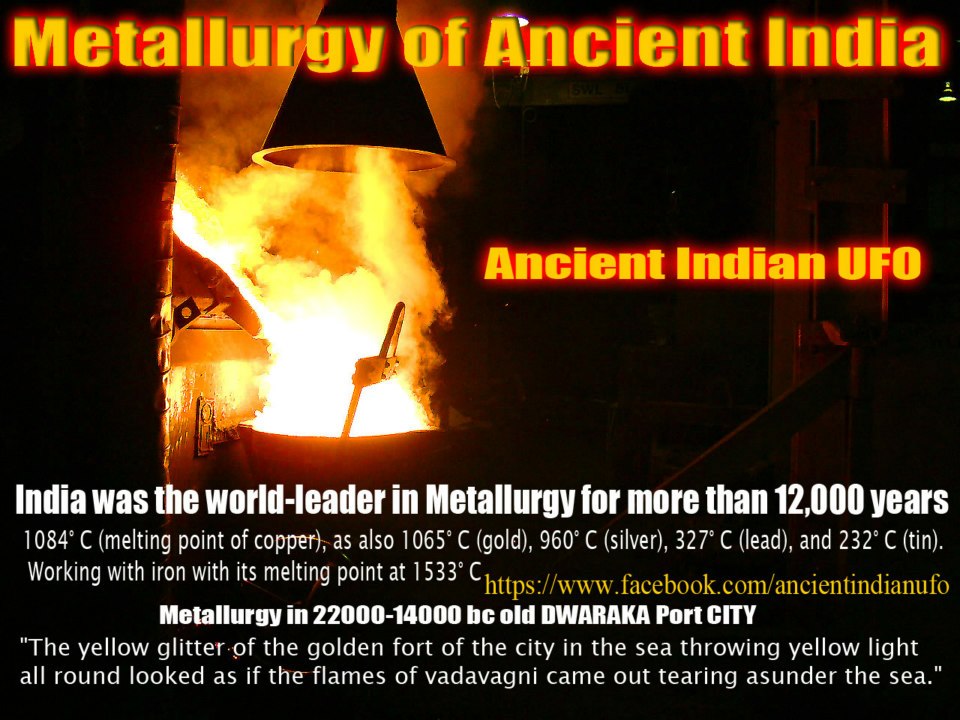
India
was the world-leader in Metallurgy for more than 22,000 - 14000 bc
years. Dwaraka City found recently Is the city of Gold.One parah says:
"The yellow glitter of the golden fort of the city in the sea throwing
yellow light all round looked as if the flames of vadavagni came out
tearing asunder the sea." The city had 700,000 palaces made of gold,
silver and other precious stones.
Gold jewelery
is available from 3,000 BCE. Brass and bronze pieces are dated back to
1,300 BCE. Extraction of zinc from ore by distillation was used in India
as early as 400 BCE while European William Campion patented the process
some 2,000 years later. Copper statues can be dated back to 500 CE.
There is an iron pillar in Delhi dating back to 400 CE that shows no
sign of rust or decay. The earliest know book on metallurgy was known
to be written by Nagarjuna in 10th century. The book Rasaratnanakara
addresses various metallurgical topics such as: Preparation of liquids
(rasas) such as MercuryExtraction of metals like Gold, Silver, Tin, and
Copper from their ores and their purificationThe processes of
liquefaction, distillation, sublimation, and roastingIndia was invaded
by Mohammedans during the time of Nagarjuna. It is possible that
Nagarjuna’s texts fell into the hands of the invaders, who could have
transmitted these Indian Metallurgical sciences to the outside world.
Metallurgy in India has a long and varied history. Bronze and copper
were known during the period of the Indus Valley Civilization. The
recovery of metal articles (including a bronze dancing girl) and the
discovery of crucible with slag attached are clear indicators of the
knowledge of casting (pouring molten-hot metal into moulds of the
desired shape and size) and forging (hammering hot metal into required
shapes). Further, this points to the fact that these early peoples could
produce and handle temperatures as high as 1084° C (melting point of
copper), as also 1065° C (gold), 960° C (silver), 327° C (lead), and
232° C (tin). Working with iron with its melting point at 1533° C was
inarguably a later achievement. Mohenjodaro, Harappa and Lothal are the
three major sites of this civilization. At Lothal in the state of
Gujarat, two types of kilns have been excavated, One, a circular kiln
that measures 1 metre in diameter, that was most probably used for
smelting copper ingots; the second, a rectangular kiln measuring 75 by
60 cms. with a depth of 30 cms. This is believed to have been used for
casting tools. The many metal discoveries at Lothal include figure,
amulets, pins in the shape of a bird-head, miniature figures, and tools
such as a curved or circular saw, a needle with an eye at the piercing
end, and a bronze drill with twisted grooves. This last is by far the
most important find of ancient tools because this single item led to an
unparalleled precision at the time, and is widely regarded as the
precursor to modern machine tools. The above-mentioned tools are
exceptional in the entire Indus Valley civilization, and neither do they
bear resemblance to Harappan tools. Indeed, Lothal was already a
prosperous town prior to the arrival of the Harappans sometime around
2450 BC and till 1600 BC. One thousand and fifty BC is usually accepted
as the year the Iron Age began in most of India. Iron is mentioned by
the Atharvaveda, referred to specifically as ayas. Previous to this, the
Vedas used the term ayas as a generic one for metals : the Brahmanas
and the Upanishads referred to Lohitayas (i.e. red metal or copper) and
Krishnayas (i.e. black metal). One thousand BC is the accepted date for
the appearance of extracted iron. Iron and its technology gave momentum
to the process of urbanization, and the lives of the peoples changed in
reflection. Iron was closely associated with : o Painted Grey Ware
Culture — the iron objects of this association date back to 1025 +/-
110 BC. Excavations have revealed arrowheads (including leaf-shaped
ones), daggers, hoes, adzes, spearheads with tongs, fish hooks, and
plain tongs. A vital site – Atranjhikera – has yielded implements at
practically every level of excavation! Other sites are Hastinapur,
Alamgirpur, Kausambi and Ujjain. o Black-and-Red-Ware-Culture — objects
discovered at Eran in the state of Madhya Pradesh date back to 1250 BC
and 700 BC, according to C14 dating. Another site, Nagda, has 59
objects, all belonging to the period 750-500 BC. These include a
double-edged dagger, the round socket of a broken axe, arrowheads with a
biconical cross-section, a celt with a wide cutting edge, spoon, nails,
clamps, and knife blades. o Megalithic Culture — While the rest of the
country proceeded from the Neolithic to the Copper and then to the Iron
Age, South india moved directly from the Neolithic to the Iron Age. At
Hallur, the Iron Age is believed to have begun in 1105 BC, while the
rest of the South coincided with the North i.e. approximately between
1050 and 950 BC. Spread throughout this region, implements and tools are
marked by their similarity. Flat iron axes, sickles, spades, daggers,
swords, knives, chisels, tripods, horse-bits, frying pans, ladles and
even bangles – all point to a usage for both domestic and warfare
purposes. Taxila stands apart due to the clear Graeco-Roman influence,
for example, ladles with vertical handles, folding chairs, candelbras,
plate armour for men and horses, cheekbars. Of special interest are the
arrowheads that are distinctly Mediterranean in style, and made their
appearance in both distant regions in AD 1! The Special Four 1) The
Iron Pillar in the Qutb Minar complex at New Delhi is an AD 310
structure, and has survived corrosion-free! It stands at 23 feet & 8
inches, upper diameter – 12.5 inches, lower diameter – 16.5 inches, and
weighs 6 tonnes. Analysis of the pillar – iron: 99.720%, carbon:
0.080%, silicon: 0.046%, sulphur: 0.006%, phosphorus: 0.114%, manganese:
negligible. The low levels of sulphur and manganese, and the relatively
high level of phosphorus, are credited with its rust-free existence.
2) Iron Pillar at Dhar (near Indore) is believed to have been built
during Chandragupta Vikramaditya’s reign, between AD 375 – 413.
Originally 50 feet in height, it has an average cross-setion of104
square inches, and weighs 7 tonnes. Unfortunately, the pillar is now in
three parts. 3) Iron beams (29 of them) at the temple at Konark (near
Puri) – the largest measures 35 feet by 6 inches, and the second in
size, 25 feet by 6 inches. Both have a cross-section of 11 inches by 11
inches. The temple was constructed sometime around AD1240. 4) The 232
beams of the twelfth century Gundicha Bedi Temple at Puri! The longest
beam is 17 feet in length, and cross-sections of the beams vary from 6
inches by 4 inches to 5 inches by 5 inches. In Arthasastra : The Wisdom
of the Wise: Kautilya’s magnum opus, the Arthashastra, is regarded by
many a scholar as the last word in sense and cunning. Here, we briefly
focus on the former aspect! Written in the fourth century BC, the work
discusses metals and minerals, the purification of their ores, the
extraction and working of metals, as well as their alloys. On one hand,
the book suggests the purification of ores by chemical treatment with
iron or alkalis (i.e. plant ashes). On the other, it recommends the use
of charcoal and chaff (waste products of food preparation) in limekiln
and for smelting iron. Clearly, recycling mattered! In addition, there
are pointers to the location of mineral deposits. The Arthasastra lays
down the role of the Director of Metals, the Director of Forest Produce
and the Director of Mining. It is the duty of the Director of Metals to
establish factories for different metals. The Director of Mines is
responsible for the inspection of mines. The Arthasastra also refers to
counterfeit coins. The Rig Veda refers to ayas, and also states that
the Dasyus had Ayas (RV 2.20.. In RV 4.2.17, “the gods [are] smelting like copper/metal
ore the human generations”. The references to Ayas in the Rig Veda
probably refer to bronze or copper rather than to iron. The Atharva Veda
and the Satapatha Brahmana refer to krsna ayas (“black metal”), which
could be iron (but possibly also iron ore and iron items not made of
smelted iron). There is also some controversy if the term syamayas
(“black metal) refers to iron or not. In later texts the term refers to
iron. In earlier texts, it could possibly also refer to
darker-than-copper bronze, an alloy of copper and tin. Copper can also
become black by heating it. Oxidation with the use of sulphides can
produce the same effect. The Yajurveda seems to know iron. In the
Taittiriya Samhita are references to ayas and at least one reference to
smiths. The Satapatha Brahmana 6.1.3.5 refers to the smelting of
metallic ore. In the Manu Smriti (6.71), the following analogy is found:
“For as the impurities of metallic ores, melted in the blast (of a
furnace), are consumed, even so the taints of the organs are destroyed
through the suppression of the breath.” Metal was also used in
agriculture, and the Buddhist text Suttanipata has the following
analogy: “for as a ploughshare that has got hot during the day when
thrown into the water splashes, hisses and smokes in volumes…” In the
Charaka Samhita an analogy occurs that probably refers to the lost wax
technique. The Silpasastras (the Manasara, the Manasollasa
(Abhilashitartha-Chintamani) and the Uttarabhaga of Silparatna) describe
the lost wax technique in detail. The Silappadikaram says that
copper-smiths were in Puhar and in Madura. According to the History of
the Han Dynasty by Ban Gu,Kashmir and “Tien-chu” were rich in metals. An
influential Indian metallurgist and alchemist was Nagarjuna (born 931).
He wrote the treatise Rasaratnakara that deals with preparations of
rasa (mercury) compounds. It gives a survey of the status of metallurgy
and alchemy in the land. Extraction of metals such as silver, gold, tin
and copper from their ores and their purification were also mentioned in
the treatise. The Rasa Ratnasamuccaya describes the extraction and use
of copper. He wrote the treatises Rasaratnakara, Rashrudaya and
Rasendramangalthat deals with preparations of rasa (mercury) compounds.
It gives a survey of the status of metallurgy and alchemy in the land.
Extraction of metals such as silver, gold, tin and copper from their
ores and their purification were also mentioned in the treatise. He also
wrote Uttaratantra as a supplement to Susrutasamhita, dealing with
preparation of medicinal drugs, and an Ayurvedic treatise,
Arogyamanjari. His other treatises are Kakshaputatantra, Yogasara and
Yogasatak. Because of his profound scholarliness and versatile
knowledge, he was also appointed as Chancellor of the famous University
of Nalanda. Varahamihira in the sixth century AD indicates the
hardening of steel in his Khargalakshanam:: ” The red hot steel should
be plunged into a solution of plantain ashes in whey, which is kept
standing for twelve hours and then it should be sharpened on the lathe.”
Vrinda discussed the process of killing iron (i.e. obtaining iron
oxides). He insists that iron first be ignited in fire and then immersed
in the juices of Emblic myrobalan and Trewia nundiflora. Next, it
should be exposed to sunlight, and then again macerated in certain other
plant juices. Last, it should be placed in a mortar and rubbed. The
twelfth century Brahmanical Tantric text Rasarnava holds forth on the
colour of flames, the processes of killing metals, and the test of a
pure metal. The last – ”A pure metal is one which when melted in a
crucible does not give off sparks nor bubbles, nor spurts, nor emits any
sound, nor shows any lines on the surface but is tranquil like a gem.”
Another text Rasaratnasamuchchaya speaks of iron as one of the pure
metals, and the three categories thereof: (i) Mundam (wrought iron) is
of three types – one is the mridu, that is glossy, will melt easily but
is difficult to break; the second, kunthum, that does not melt easily;
and the kadaram that will easily break under the hammer; (ii) Tikshnam
(cast iron steel) – of six types, ranging from the line-free and rough
and breakable type to the sharp-edged type that is difficult to break.
(iii) Kantam is of five types – bhramaka (that can make iron move
about), chumnbaka (that which ‘kisses’ iron), karshaka (that which
attracts iron), dravaka (which melts iron easily), romakanta (which
expels hair-like filaments upon breaking). Other metals: Zinc mining
and smelting were known in the fourteenth century, and soldering was a
common practice. By the eighteenth century, steel manufacture was a
regular industry, particularly in Mysore. Seringapatnam was famous for
its steel wires for musical instruments, while iron utensils and
furniture were hallmarks of the smiths of Birbhum in the state of Bengal
and Munger in the state of Bihar.
The Greatest Civilization ever existed on this planet EARTH. Please share and Tag with Pride.
Jai Sri Ram
Source https://www.facebook.com/ancientindianufo

:
But recent discovery of 14000+ BC year old city found.Which had a huge
Dock and Port.It is a port city .So it Proves Ancient Hindus invented
Ships too. Greatest Civilization on this Planent Yest to be Declared has
Mother of All Human Civilization. Truth can be hidden But History
cannot be changed.All western civilizations are puzzled by the facts
emerge one by one every day and every
minute. The time will come all human will return to their Mother
Religion Real Culture. Jai Sri RAM... Read More
The art of
Navigation was born in the river Sindhu 6000 years ago. The very word
Navigation is derived from the Sanskrit word ‘Navgatih’. The word navy
is also derived from Sanskrit ‘Nou’. In those days India had colonies,
in Cambodia (Kambuja in Sanskrit) in Java, (Chavakam or Yava dwipa) in
Sumatra, in Borneo, Socotra (Sukhadhara) and even in Japan. Indian
traders had established settlements in Southern China, in the Malayan
Peninsula, in Arabia, in Egypt, in Persia, etc., Through the Persians
and Arabs, India had cultivated trade relations with the Roman Empire.
Sanskrit and Pali literature has innumerable references to the maritime
activity of Indians in ancient times. There is also one treatise in
Sanskrit, named Yukti Kalpa Taru which has been compiled by a person
called Bhoja Narapati. (The Yukti Kalpa Taru (YKT) had been translated
and published by Prof. Aufrecht in his ‘Catalogue of Sanskrit Manu
scripts. An excellent study of the YKT had been undertaken by Dr. Radha
Kumud Mookerji entitled ‘Indian Shipping’. Published by Orient Longman,
Bombay in 1912.) A panel found at Mohenjodaro, depicting a sailing
craft. Vessels were of many types Their construction is vividly
described in the Yukti Kalpa Taru an ancient Indian text on
Ship-building. This treatise gives a technocratic exposition on the
technique of shipbuilding. It sets forth minute details about the
various types of ships, their sizes, the materials from which they were
built. The Yukti Kalpa Taru sums up in a condensed form all the
available information The Yukti Kalpa Taru gives sufficient information
and date to prove that in ancient times, Indian shipbuilders had a good
knowledge of the materials which were used in building ships. Apart
from describing the qualities of the different types of wood and their
suitability in shipbuilding, the Yukti Kalpa Taru also gives an
elaborate classification of ships based on their size. The primary
division is into 2 classes viz. Samanya (ordinary) and Vishesha
(Special). The ordinary type for sea voyages. Ships that undertook sea
voyages were classified into, Dirgha type of ships which had a long and
narrow hull and the Unnata type of ships which had a higher hull. The
treatise also gives elaborate directions for decorating and furnishing
the ships with a view to making them comfortable for passengers. Also
mentioned are details about the internal seating and accommodation to be
provided on the ships. Three classes of ships are distinguished
according to their length and the position of cabins. The ships having
cabins extending from one end of the deck to the other are called
Sarvamandira vessels. These ships are recommended for the transport of
royal treasure and horses. The next are the Madhyamarnandira vessels
which have cabins only in the middle part of their deck. these vessels
are recommended for pleasure trips. And finally there is a category of
Agramandira vessels, these ships were used mainly in warfare.
MACCHA-YANTRA – THE ANCIENT INDIAN MARINER’S COMPASS There were
Sanskrit terms for many parts of a ship. The ship’s anchor was known as
Nava-Bandhan-Kilaha which literally means ‘A Nail to tie up a ship’ .
The sail was called Vata Vastra a which means ‘wind-cloth’. The hull was
termed StulaBhaga i.e. an’expanded area’. The rudder was called
Keni-Pata, Pata means blade; the rudder was also known as Karna which
literally means a ‘ear’ and was so called because it used to be a hollow
curved blade, as is found today in exhaust fans. The ship’s keel was
called Nava-Tala which means ‘bottom of a ship’. The mast was known as
Kupadanda, in which danda means a pole. Even a sextant was used for
navigation and was called Vruttashanga-Bhaga. But what is more
surprising is that even a contrived mariner’s compass was used by Indian
navigators nearly 1500 to 2000 years ago. “The early Hindu astrologers
are said to have used the magnet, in fixing the North and East, in
laying foundations, and other religious ceremonies. The Hindu compass
was an iron fish that floated in a vessel of oil and pointed to the
North. The fact of this older Hindu compass seems placed beyond doubt by
the Sanskrit word Maccha Yantra, or fish machine, which Molesworth
gives as a name for the mariner’s compass”. It is significant to note
that these are the words of a foreign Naval Architect and Shipbuilding
Expert. It is thus quite possible that the Maccha Yantra (fish machine)
was transmitted to the west by the Arabs to give us the mariner’s
compass of today. Indian shipping has thus had a long and brilliant
history covering a period of about five millennia from the very dawn of
India’s civilization in the Indus Valley. Both Hindu and Buddhistic
texts are thus replete with references to the sea-borne trade of India
that directly and indirectly demonstrate the existence of a national
shipping and shipbuilding. It was one of the great national key industry
of India. Indeed, all the evidence available clearly shows that for
full thirty centuries India stood at the very heart of the commercial
world, cultivating trade relations successively with the Phoenicians,
Jews, Assyrians, Greeks, Egyptians, and Romans in ancient times, and
Turks, Venetians, Portuguese, Dutch and English in modern times. There
is enough evidence to prove that Indians maintained their maritime
activity through out the ancient and mediaeval periods, naturally with
variations in its extent and excellence, over such a long period of
time. Both Basham and Marxist historians of India have presented
untruth, and half truth as truth. Sylvain Levi French art Historian has
shown how references in the Ramayana, Mahabharata, Mahaniddesa and
Brihat-Katha that the products of Burma and Malaya Peninsula were known
to Indian merchants and sailors and also some of its ports such as
Suvarnakudya, Suvarnabhumi, Takkolam, Tamlin and Javam from at least
first century A.D. (source: Ancient India – By V. D. Mahajan p.
752-753). That Indian traders and settlers repeatedly undertook
journeys to Southeast Asia, despite the hazards and perils involved,
speaks well for their physical prowess, courage, and determination, even
if allowance for the pull of profit is made. Historian K. M. Panikkar,
who in his brilliant exposition, India and the Indian Ocean, speaks
about the ‘influence of the Indian Ocean on the shaping of Indian
history.’ For Panikkar, the geographical ‘imperative’ of the Indian
Ocean – and indeed the Himalaya in the North – has conditioned and
shaped the history and civilization of this subcontinent. ‘The
importance of geographical path on the development of history is only
now receiving wide and general recognition,’But recent discovery of
14000+ BC year old city found.Which had a huge Dock and Port.It is a
port city .So it Proves Ancient Hindus invented Ships too. Greatest
Civilization on this Planent Yest to be Declared has Mother of All Human
Civilization. Truth can be hidden But History cannot be changed.All
western civilizations are puzzled by the facts emerge one by one every
day and every minute. The time will come all human will return to their
Mother Religion Real Culture. Jai Sri RAM


